

Best Serum for Combination Skin: How to Choose the Right One
Introduction
Most people don't have just one skin type. If your cheeks feel dry or normal but your forehead, nose and chin get shiny by afternoon, you have combination skin — and it's the trickiest type to shop for, because most serums are built for one problem, not two at once.
A good face serum for combination skin does two jobs together: it hydrates the dry areas without making them feel heavy, and it controls oil and shine in the T-zone without stripping it dry. Get this balance wrong and you end up with dullness, uneven texture, and more breakouts around the nose and chin — the exact complaints combination-skin readers search for most.
This guide covers what combination skin actually needs, which ingredients genuinely help, which Mystic Dust products contain them, and how to build a routine around it — without wasting money on products doing the same job twice.
What Is Combination Skin?
Combination skin means two skin behaviours on one face: an oily T-zone (forehead, nose, chin) with visibly larger pores, alongside cheeks that stay dry, normal, or only mildly oily. It's the most common skin type reported in India, largely because of heat and humidity through most of the year.
The mistake most people make is treating combination skin like it's just oily skin with dry patches and picking one product for the whole face. That usually means the T-zone stays shiny while the cheeks get more irritated — the product was never built to do both jobs.
Why Combination Skin Needs a Serum, Specifically
A serum is a lightweight, concentrated formula built to deliver active ingredients deep into the skin — unlike a moisturizer, which mostly sits on the surface to lock in hydration. For combination skin, that concentration matters because you need real actives doing real work in both zones at once: hydrating where it's dry, controlling oil where it's not, and evening out the texture and tone gap between the two.
Used correctly, a serum can help with:
- Hydrating dry cheeks without adding heaviness
- Balancing oil production in the T-zone
- Improving overall skin texture
- Reducing breakouts around the nose and chin
- Brightening dullness and evening out tone
- Minimizing the look of enlarged pores
Key Ingredients to Look For
Hyaluronic Acid — A humectant that pulls moisture into the skin without clogging pores, which is exactly why it works for both the dry cheeks and the oily T-zone at once — most other hydrators are too heavy for combination skin's oilier areas.
Niacinamide — One of the most useful all-round actives for combination skin: it helps regulate oil production, supports a more even-looking pore appearance, and calms redness and breakout-prone areas, all without drying out the cheeks.
Vitamin C — A well-studied antioxidant that helps brighten an uneven skin tone and supports the skin's defence against everyday environmental exposure (sun, pollution); also associated with a reduced look of acne marks and dark spots over consistent use.
Salicylic Acid — A beta-hydroxy acid that works inside the pore, making it genuinely useful for the oily T-zone specifically: it helps with deep cleansing, reduces blackheads, and helps prevent new breakouts. Best used in the T-zone or as a cleanser, not necessarily across the whole face.
Ceramides — Naturally occurring lipids that help rebuild and maintain the skin's protective barrier. For combination skin, ceramides matter because a compromised barrier is what makes both zones worse — the T-zone overproduces oil to compensate, and the cheeks lose moisture faster.
Green Tea Extract (Camellia Sinensis) — An antioxidant-rich botanical that helps soothe visible redness and irritation while offering some support against daily environmental stress; often paired with actives like caffeine and peptides in targeted formulas.
What's Actually in Our Formulas
Not every ingredient combination skin benefits from is in every Mystic Dust product — here's what's genuinely in our current lineup, so you know exactly what you're buying rather than guessing from a generic ingredient list:
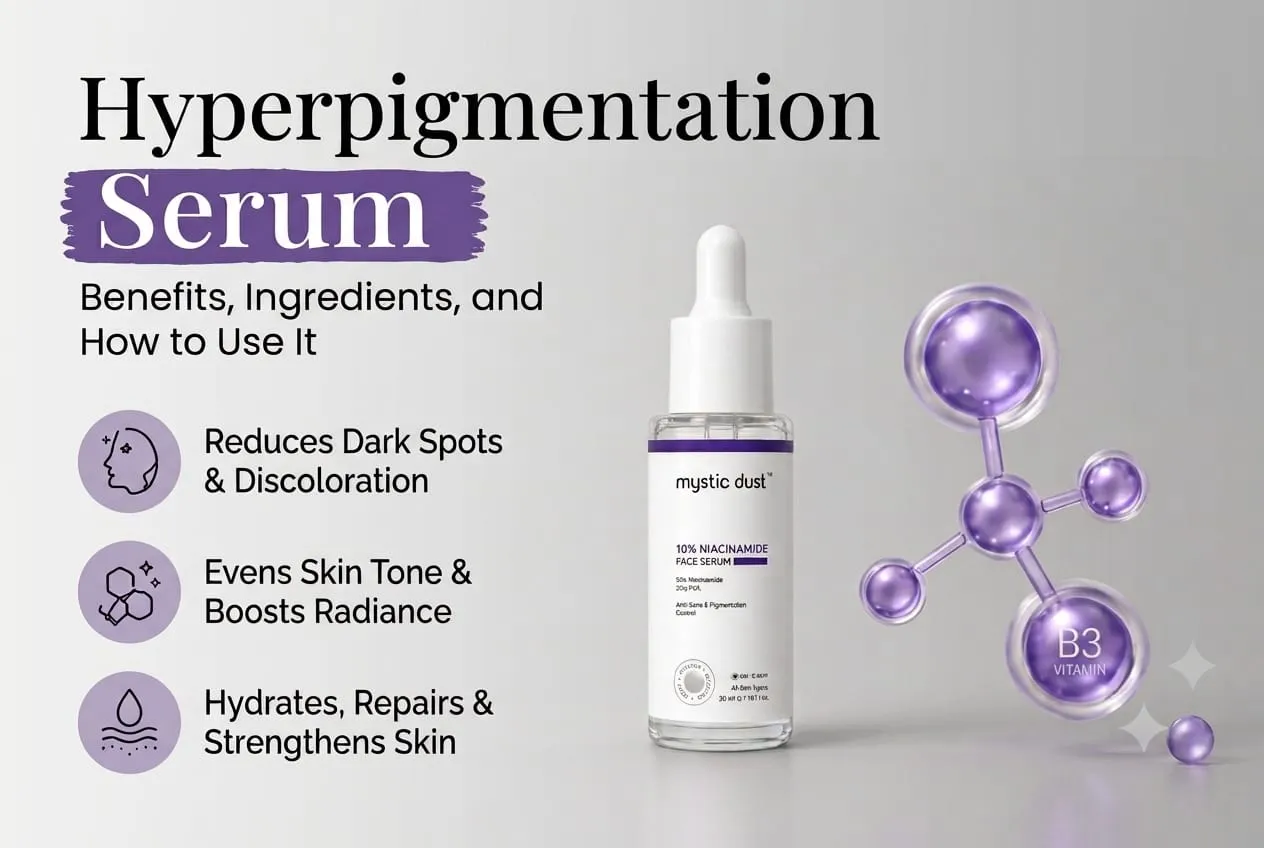
- Niacinamide is the lead active in our 10% Niacinamide Face Serum, alongside Zinc PCA, Alpha-Arbutin, Potassium Azeloyl Diglycinate and Licorice — built for oil control, pore appearance, and pigmentation together.
- Vitamin C and Hyaluronic Acid are both in our 10% Vitamin C Face Serum, alongside Kakadu Plum, Ferulic Acid and Vitamin E — built for brightening and tone.
- Salicylic Acid (around 1%) is in our Anti-Acne Face Wash — a cleanser-level dose, formulated for the oily T-zone step of your routine, not a leave-on serum.
- Ceramides and Hyaluronic Acid are both in our Hydration Boost Moisturizer, alongside Lipomoist — this is the barrier-support step for the dry-cheek side of combination skin.
- Green Tea Extract is genuinely in our formulations, but currently in the Under Eye Gel, not in a face serum or moisturizer — worth knowing if you were specifically shopping for it in a serum.
Ingredients to Avoid
Thick butters, mineral oil, coconut oil, and heavy petroleum-based ingredients can feel great on dry cheeks but tend to clog pores and worsen breakouts in the T-zone — exactly the trade-off combination skin can't afford. Look for water-based or gel-based formulas instead, which is also why lightweight serums work better here than rich creams alone.
How to Choose the Right Serum
1. Match ingredients to your actual concern. Oily and breakout-prone → check Oily Skin & Acne. Dry and dehydrated → check Dry & Dehydrated Skin. Dull and uneven tone → check Dark Spots & Pigmentation.
2. Choose lightweight, fast-absorbing formulas. Water-based or gel-based serums sink in quickly and won't sit heavy on the oily T-zone, while still delivering enough hydration for the drier areas.
3. Prefer non-comedogenic formulas. This lowers the risk of the serum itself clogging pores — genuinely more important for combination skin than for drier skin types, since even a small amount of extra oil in the T-zone shows up fast.
4. Patch test before full use. Apply a small amount on your inner arm or jawline for 24 hours before using any new active on your full face — this holds regardless of how gentle a product claims to be.
How to Use It — Step by Step
- Cleanse with a mild, sulfate-free, pH-balanced face wash. If your T-zone runs oily, an active-cleanser step (like a Salicylic Acid face wash) can help without over-drying the cheeks.
- Tone, if you use one — a lightweight, alcohol-free toner preps the skin without adding extra oil.
- Apply your serum. 2–3 drops is enough. Pat it in gently across the whole face, focusing extra on the areas that need it (hydration on the cheeks, oil control at the T-zone).
- Moisturize. Choose an oil-free, gel-based or lightweight lotion-style moisturizer — even oily skin needs hydration, and skipping this step often makes the T-zone produce more oil to compensate.
- Sunscreen, every morning. No serum routine works long-term without daily SPF — see our Sunscreen Guide if you're not sure which to pick for combination skin.
What to Expect
Most people notice their T-zone feeling less shiny and their cheeks feeling less tight within 2–4 weeks of consistent use. Visible improvements in tone, texture and pore appearance generally take 6–8 weeks of regular use — skincare results build gradually, and consistency matters more than any single product.
Common Mistakes to Avoid
- Using multiple active serums together. Layering Vitamin C, Niacinamide, and Salicylic Acid all at once can irritate skin rather than help it — introduce one active at a time.
- Using too much product. More isn't better with a serum — 2–3 drops is genuinely enough; excess just sits on the skin without added benefit.
- Copying an influencer's exact routine. What works for someone else's skin type and climate may not suit yours — build your routine around your own concerns, not someone else's.
- Using strong actives too frequently. Ingredients like Salicylic Acid or Vitamin C can irritate skin if overused — start at 2–3 times a week and build up gradually.
- Mixing incompatible ingredients in the same routine. Vitamin C and Retinol, for example, are best kept in separate routines (Vitamin C in the morning, Retinol at night) rather than layered together — see our FAQ below for the full AM/PM breakdown.
Conclusion
Combination skin isn't complicated once you stop treating it like one skin type. The real goal is balance: enough hydration for the dry areas, enough oil control for the T-zone, and ingredients that can genuinely do both without irritating either.
Start with 10% Niacinamide Face Serum if oil and pores are your main concern, or 10% Vitamin C Face Serum if dullness and uneven tone bother you more. Pair either with Hydration Boost Moisturizer to keep the dry areas comfortable, and Anti-Acne Face Wash if your T-zone needs a stronger cleanse. Not sure where to start? Explore our full Face Serum range.