
The Complete Guide to Hair Growth Serums: Ingredients, Usage & Results
Introduction
Hair fall, thinning, or slow growth can come from a dozen different places — stress, pollution, poor diet, harsh weather, or just genetics. A hair growth serum won't fix all of them, but a well-formulated one, used consistently, can genuinely support your scalp and follicles while you also deal with the underlying cause.
This guide walks through what a hair growth serum actually is, which ingredients are worth knowing about, how to use one properly, and what's realistic to expect — including which of these ingredients are actually in Mystic Dust's own formula, and which aren't. If you're trying to figure out what's causing your hair fall in the first place, our Hair Thinning Causes & Treatment guide covers that in depth.
What Is a Hair Growth Serum?
A hair growth serum is a light, non-greasy liquid you apply directly to your scalp rather than your hair strands. Because it's applied at the root, it's designed to work on the follicle itself — supporting the scalp environment where hair actually grows, rather than just coating the strand the way a conditioner or oil does.
Key Ingredients to Look For in a Hair Growth Serum
Here's what the most commonly used actives in this category actually do, based on how each one is studied:
Redensyl — studied for its effect on the follicle's stem cells, supporting the start of a new growth cycle.
Anagain — a pea sprout extract studied for helping hair move out of its resting phase sooner, supporting fuller-looking density over time.
Procapil — studied for supporting the scalp against DHT-related follicle thinning. It isn't an outright DHT blocker the way a prescription medication can be — think of it as scalp support, not a guaranteed mechanism.
Capilia Longa — derived from turmeric, studied for scalp and follicle support, including helping calm an irritated scalp.
Biotin — supports strand strength and helps reduce breakage over time.
Caffeine — commonly included for scalp circulation support, which may help create a better environment for hair follicles.
Saw Palmetto — another plant-based ingredient some serums use for its studied effect on DHT-related thinning. Not currently part of Mystic Dust's own Hair Growth Serum formula.
A Note on Minoxidil
You'll often see Minoxidil mentioned in hair growth conversations, so it's worth being clear about what it actually is: Minoxidil is a regulated medication, not a cosmetic ingredient — it needs to be used under medical guidance, and it works differently from the plant-based and stem-cell-focused actives above. Mystic Dust's Hair Growth Serum does not contain Minoxidil. If you're considering it, that's a conversation to have with a dermatologist, not a decision to make from a product label alone.
What's Actually in Mystic Dust's Hair Growth Serum
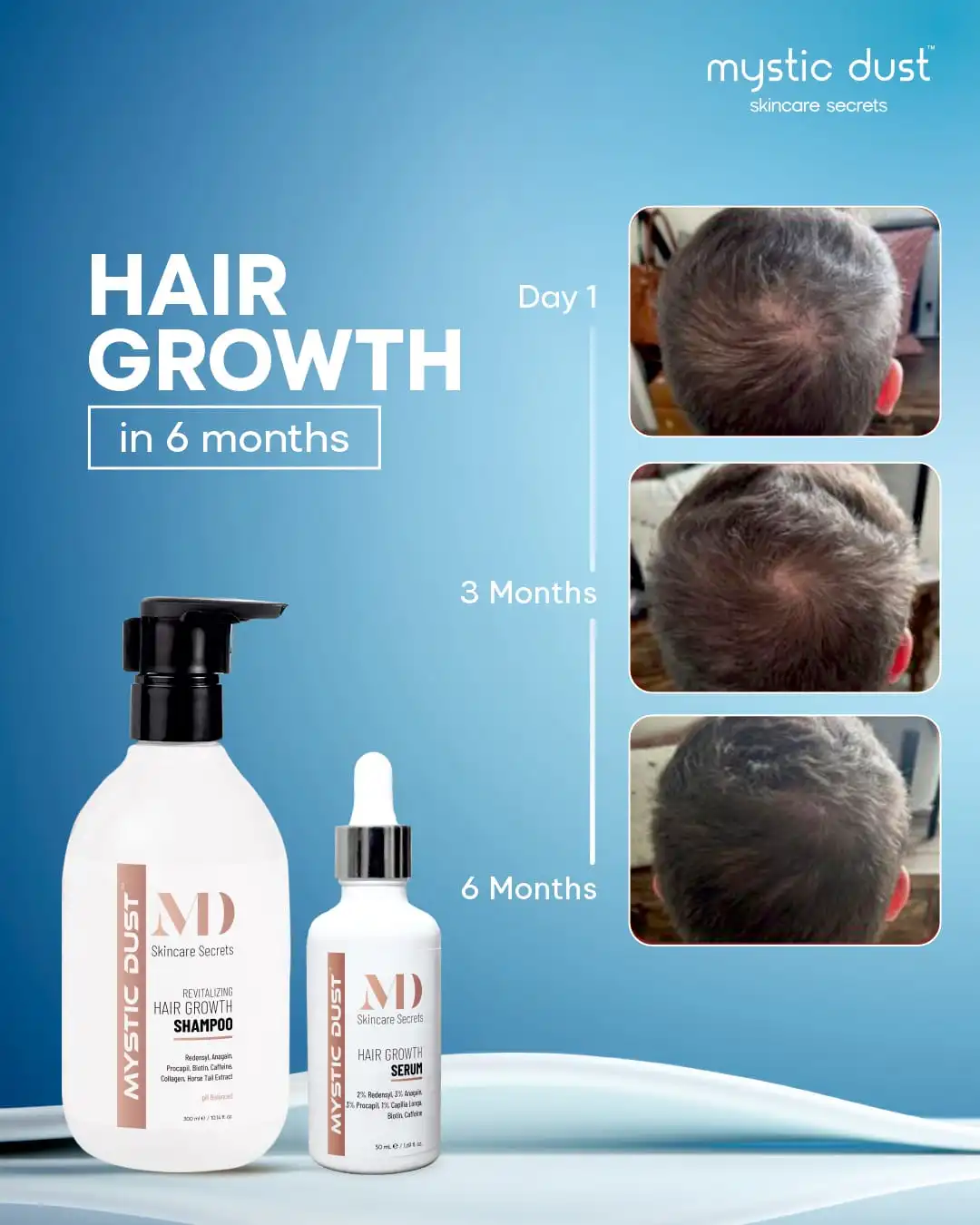
Our formula combines Redensyl, Anagain, Procapil, Capilia Longa, Biotin and Encapsulated Caffeine — chosen to support the growth cycle from a few different angles at once, rather than relying on a single ingredient to do everything.
See the full Hair Growth Serum formulation →
How to Use Hair Growth Serum for Best Results
- Apply directly to your scalp (not the hair strands), using the dropper.
- Gently massage in for 3–5 minutes to help with absorption and circulation.
- Leave it in — no need to rinse. Use it as part of your night routine.
- Use daily for consistent scalp contact.
What to expect: most people notice less shedding within a few weeks of consistent use, with visible improvements in density typically building over 10–12 weeks. Results vary depending on what's causing your hair fall in the first place and how consistently the serum is used — it isn't an overnight fix, and no honest brand should tell you otherwise.
Who Should Use a Hair Growth Serum?
- Anyone noticing more hair fall than usual, thinning, or a widening part
- Men dealing with early pattern thinning who want a cosmetic, daily-use option alongside any medical treatment they're already on
- Women looking to support hair density and texture
- Anyone with a dry or easily irritated scalp, since a lightweight serum is often more comfortable than a heavier oil
Talk to a dermatologist first if: your hair loss is sudden, patchy, or comes with scalp pain or irritation — a serum works best on general thinning, not as a stand-alone fix for a diagnosed condition.
Related Reading
- The Hair Growth Cycle: Phases, Normal Shedding, and What Helps
- What Is Anagain and How Does It Help Stop Hair Loss?
- Hair Thinning Causes & Treatment: How to Fix Thinning Hair
See the full formula on the Hair Growth Serum page, or get shampoo and serum together with the Hair Growth Routine.