
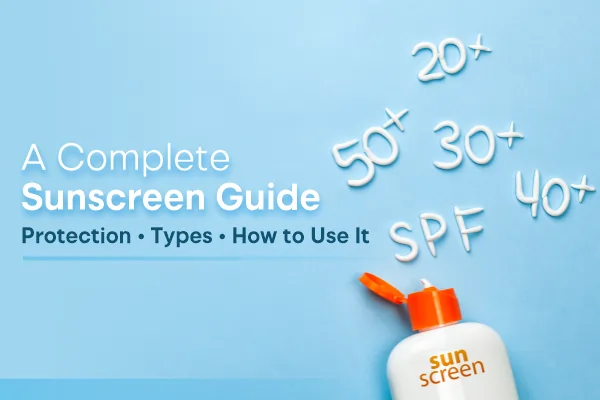
A Complete Sunscreen Guide: SPF, Types and How to Use It Right
Introduction
Sunlight isn't all bad — it lifts your mood, helps your body make Vitamin D, and even helps you sleep better at night. The problem is what happens with too much of it, unprotected, over time. The World Health Organization links long-term, unprotected UV exposure to a higher risk of skin cancer, on top of the sunburn, tanning, and early wrinkles most people already associate with too much sun.
Most people know sunscreen matters. Far fewer use it correctly — the wrong amount, the wrong frequency, or skipped entirely on cloudy or indoor days when UV rays are still very much active. This guide covers what sun damage actually is, what SPF means, the difference between mineral and chemical sunscreen, and exactly how to apply it so it does the job it's meant to.
Understanding Sun Damage and Why Protection Matters
Two types of UV rays reach your skin, and they don't do the same damage:
UVA rays go deep into the skin. Over years, this is what drives wrinkles, fine lines, and a lot of what people call premature ageing.
UVB rays work on the skin's outer layer — this is what causes sunburn, and long-term, unprotected exposure raises skin cancer risk.
A sunscreen that only handles one of these isn't doing a complete job. That's why broad spectrum on a label matters — it means the sunscreen is tested against both.
What Is SPF, Really?
SPF (Sun Protection Factor) measures how well a sunscreen blocks UVB rays specifically — not UVA, which is a separate reason broad spectrum labeling matters.
- SPF 15 blocks about 93% of UVB rays
- SPF 30 blocks about 97%
- SPF 50 blocks about 98%
No sunscreen blocks UV rays completely, and the jump from SPF 30 to SPF 50 is smaller than it sounds. Skin care experts generally recommend at least SPF 30 for daily use, with SPF 50 giving you a bit more margin if you're outdoors for long stretches or don't reapply exactly on schedule.
Mineral vs. Chemical Sunscreen — What's the Difference?
Mineral sunscreen uses ingredients like titanium dioxide and zinc oxide. It sits on top of your skin and physically reflects UV rays, which means it starts working the moment you apply it. It's often the first recommendation for sensitive skin, young children, or very acne-prone skin — but it can feel heavier and sometimes leaves a visible white cast, especially on deeper skin tones.
Chemical sunscreen uses ingredients like octinoxate or avobenzone. It absorbs UV rays and converts them to heat, which the skin then releases. It needs 15-20 minutes to start working after application, but it's typically lighter, absorbs faster, and doesn't leave a white residue — though it can irritate some sensitive skin types.
Sunscreens also come in different formats depending on where and how you'll use them: creams for dry skin, gels for oily and acne-prone skin, sticks for small areas like eyes and lips, and sprays for the body.
Mystic Dust's Advanced Matte Sunscreen Gel is a chemical-filter formula, built as a gel rather than a cream. That combination is deliberate — it's what gives it the fast-absorbing, matte finish with no white cast, instead of the heavier feel and visible residue some mineral sunscreens leave behind. It's SPF 50+ and PA++++, so it covers both UVB and UVA, along with blue light from screens.
How to Apply Sunscreen — Step by Step
- Cleanse your face.
- Apply a moisturizer first, if that's part of your routine.
- Apply sunscreen generously — most people use far less than the amount a product was actually tested at, which quietly lowers the real-world protection you're getting.
- If you're using a chemical sunscreen, wait 15-20 minutes before stepping into the sun.
- Apply makeup afterward, if you wear it — a matte gel formula like Mystic Dust's works well as a base.
How Much Sunscreen Should You Use, and How Often?
For your face and neck, aim for roughly a teaspoon's worth. For your full body, that goes up to around 30-35 grams — most people apply noticeably less than this.
Reapply every 2-3 hours if you're outdoors, and immediately after swimming or heavy sweating, even if the product is water-resistant. On a normal indoor day, one morning application is usually enough.
Why This Still Matters, Even on an Ordinary Day
Sunscreen's biggest job is prevention — protecting skin from damage before it happens, which is also why there's no dramatic before and after the way an active-ingredient serum might show. Consistent daily use is what makes SPF work, backed by decades of dermatological research and WHO guidance on limiting UV exposure to reduce skin cancer risk over time.
Mystic Dust's Advanced Matte Sunscreen Gel is built around this exact daily-use problem: SPF 50+ and PA++++ protection with Kumkumadi Oil and Niacinamide to help even out skin tone, and Ceramides and Phospholipids underneath to support your skin barrier — so wearing sunscreen every day doesn't dry your skin out over time. It's formulated for Indian heat and humidity, and made for all skin types and genders, one tube.
Sunscreen also works better paired with an antioxidant in your morning routine — a Vitamin C serum, for instance, helps your skin handle damage that's already started, while sunscreen blocks new damage before it reaches you. Use both, not one instead of the other.
Related Reading
- Niacinamide Face Serum Guide: A Complete Usage Guide
- Winter Skin Care Routine: Tips to Keep Your Skin Healthy, Soft & Hydrated
Ready to make sunscreen a daily habit that actually sticks? Try the Advanced Matte Sunscreen Gel — SPF 50+, PA++++, no white cast.