












 Aura-AI Assistant
Verdict: Myth (widely accepted trichological consensus).
The claim: Regular trims speed up hair growth or make new hair grow in thicker.
The fact: Hair growth happens at the follicle, beneath the scalp — new hair is produced from the root regardless of what happens to the visible hair shaft above the skin. Cutting the ends has no effect on the follicle’s growth rate or on the thickness of the hair that grows in next. This is standard trichological understanding rather than a single specific cited trial.
Why this myth persists: Freshly cut hair, without split or frayed ends, can look and feel thicker and healthier immediately — which reads as “faster, thicker growth” even though it’s really just the removal of damaged ends making existing hair look better.
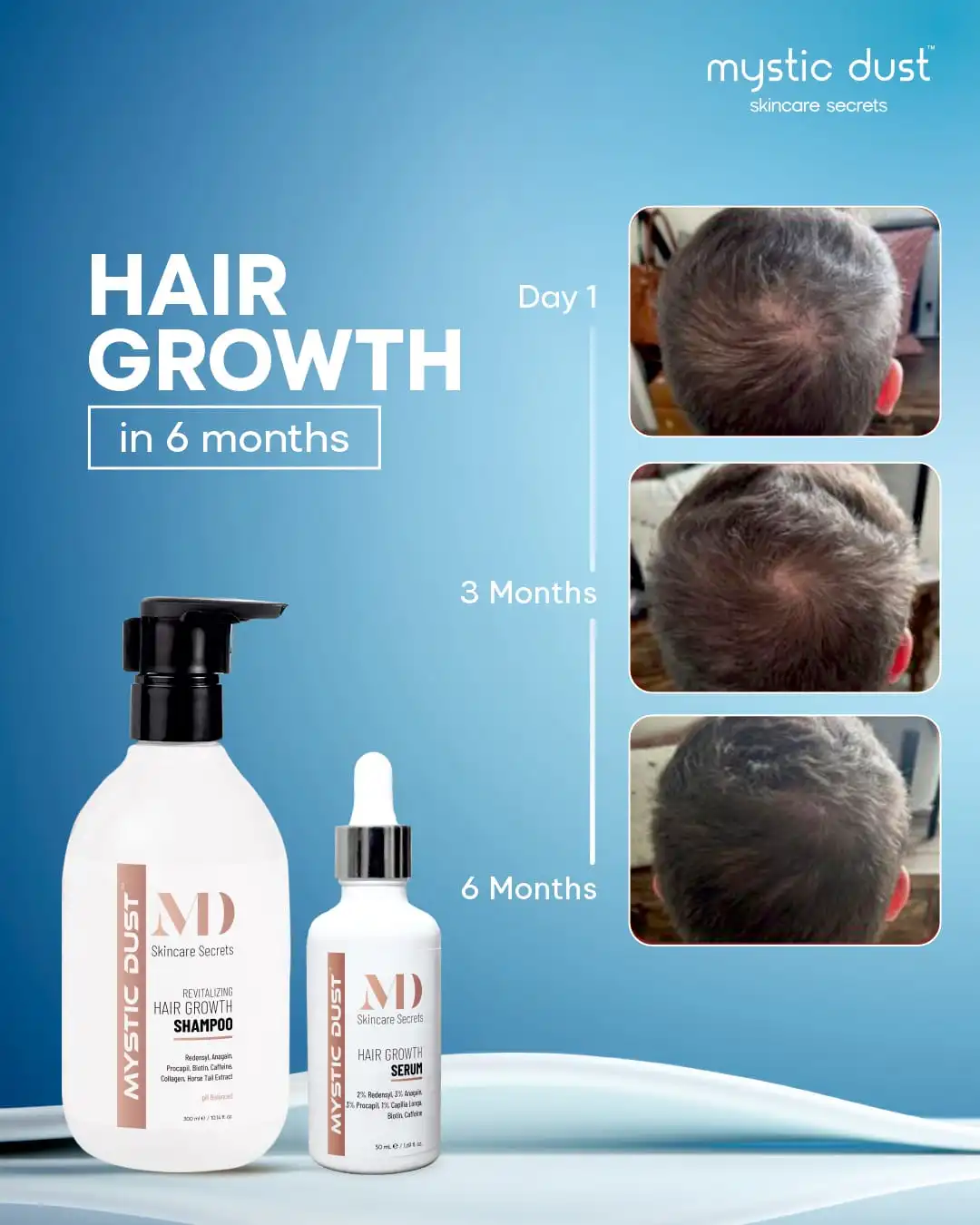
What this means for your routine: Regular trims are genuinely useful for removing split ends and preventing breakage from traveling further up the strand — a real benefit, just not the one usually claimed. For actual growth support at the follicle level, see Hair Growth Serum and Hair Growth Shampoo, or the Scalp Strength Shampoo, built on the same follicle-level actives.
Verdict: Partly myth — real benefit, but not the one usually claimed.
The claim: Regular coconut oil massage prevents hair fall.
The fact: According to PubMed, a comparative study testing coconut oil, mineral oil and sunflower oil on hair found that coconut oil was uniquely effective at reducing protein loss from hair, both before and after washing, for damaged and undamaged hair alike — attributed to its molecular structure allowing it to actually penetrate the hair shaft, unlike mineral or sunflower oil (Rele AS, Mohile RB. “Effect of mineral oil, sunflower oil, and coconut oil on prevention of hair damage.” Journal of Cosmetic Science, 2003;54(2):175-192, PMID: 12715094). This is a genuine, evidenced benefit — but it’s about reducing breakage and damage to the hair shaft during grooming, not about stopping hair fall from the follicle, which is usually driven by genetics, hormones (DHT-sensitivity) or scalp health, not surface oiling.
Why this myth persists: Less breakage during combing and washing does mean less hair ending up in your hairbrush or the shower drain, which looks and feels like “less hair fall” even when the actual follicle-level shedding rate hasn’t changed.
What this means for your routine: Oiling for shaft protection and breakage reduction is worth keeping in your routine — it’s just not a substitute for follicle-targeted actives if genuine hair thinning or fall is the concern. Hair Growth Serum and Hair Growth Shampoo — and the Scalp Strength Shampoo — use Redensyl and Anagain specifically for the follicle-level mechanism that oiling alone doesn’t address.
Verdict: Partly myth — real effect, often overstated.
The claim: Any shampoo containing sulfates (like Sodium Lauryl Sulfate) will damage hair and irritate the scalp, full stop.
The fact: According to PubMed, a controlled study measuring skin capacitance and using ex vivo bioassays on human stratum corneum found that surfactants, including sodium lauryl sulfate, do produce measurable, concentration-dependent changes to the skin’s outer barrier when applied the way shampoo is used on the scalp (Xhauflaire-Uhoda E, Loussouarn G, Haubrechts C, Léger DS, Piérard GE. “Skin capacitance imaging and corneosurfametry. A comparative assessment of the impact of surfactants on stratum corneum.” Contact Dermatitis, 2006;54(5):249-253. DOI). So the underlying concern isn’t invented — sulfates are genuinely more likely to affect barrier hydration and cause irritation than gentler surfactants, especially at higher concentrations or with frequent use on sensitive scalps. But “always damage” overstates it — the effect is dose- and frequency-dependent, and plenty of people use sulfate shampoos without visible issues.
Why this myth persists: “Sulfate-free” has become such a strong marketing signal across the haircare industry that the underlying nuance (concentration and frequency matter, not just presence or absence) gets lost.
What this means for your routine: If you have a sensitive or dandruff-prone scalp, a sulfate-free formula is a reasonable, evidence-consistent choice — which is why Hair Growth Shampoo and Scalp Reset Shampoo are both sulfate-free — a standard carried into every upcoming October 2026 launch, including Scalp Balance and Scalp Strength. It’s a genuine formulation upgrade for many people, not fear-based marketing.
Verdict: Myth (widely accepted trichological consensus).
The claim: Plucking a single grey hair causes multiple grey hairs to grow back from the same spot.
The fact: Each hair follicle operates independently, producing one hair at a time — plucking a hair from one follicle has no biological mechanism to affect the follicles around it. Greying itself is driven by declining melanocyte (pigment-cell) activity within each follicle over time, a separate process entirely from how many hairs grow from a given spot. This is standard trichological understanding, not a single cited study finding.
Why this myth persists: Grey hair does tend to spread across the scalp as a natural part of ageing, and if someone plucks a grey hair right as more happen to appear nearby, it’s easy to (incorrectly) connect the two events.
What this means for your routine: Plucking grey hairs isn’t dangerous in the “multiplying” sense, though repeated plucking from the same follicle over years can eventually damage it — trimming or coloring are gentler options if grey hair bothers you cosmetically.
Verdict: Myth.
The claim: Washing hair every day, or even every other day, causes more hair to fall out.
The fact: The average scalp sheds somewhere in the range of 50-100 hairs a day as part of the normal hair growth cycle, regardless of wash frequency — those hairs are already in their shedding phase and were going to come out regardless. Washing simply releases hairs that were already loose, often all at once, which can make hair fall look more dramatic in the shower than it actually is spread across a full day. This is standard trichological consensus rather than a single cited study result.
Why this myth persists: Seeing a visible clump of hair in the drain after washing feels like direct cause and effect, even though the hairs were shedding anyway — washing is just the moment they became visible together.
What this means for your routine: Wash based on scalp oiliness and comfort, not fear of causing fall. If shedding genuinely looks like more than the normal daily range, or comes with visible thinning, that’s worth investigating the actual cause rather than reducing wash frequency — see Hair Thinning Causes & Treatment.

Copyright © 2024–2026, Oriens Health Pvt. Ltd. | All Rights Reserved




Give your friends a reward and claim your own when they make a purchase.