












 Aura-AI Assistant
The same ingredient that wakes you up in the morning does something useful for skin and scalp too — but not quite everything the internet claims. Here’s what caffeine’s actual, published mechanisms are.
Caffeine is a naturally occurring alkaloid — the same compound found in coffee and tea — used in cosmetics for its ability to penetrate the skin barrier and act on cells directly underneath it.
According to a review of caffeine’s mechanisms in cosmetic use (Herman A, Herman AP. “Caffeine’s mechanisms of action and its cosmetic use.” Skin Pharmacology and Physiology, 2012) (DOI) , caffeine has several confirmed actions relevant to skin and scalp:
Under-eye use: anyone dealing with morning puffiness or looking for a lightweight, quick-absorbing under-eye formula. Scalp/hair use: anyone in a hair-thinning-prevention routine, as a supporting ingredient alongside the formula’s other actives — not a standalone treatment.
No real precautions — topical caffeine at cosmetic concentrations is well tolerated across skin types.
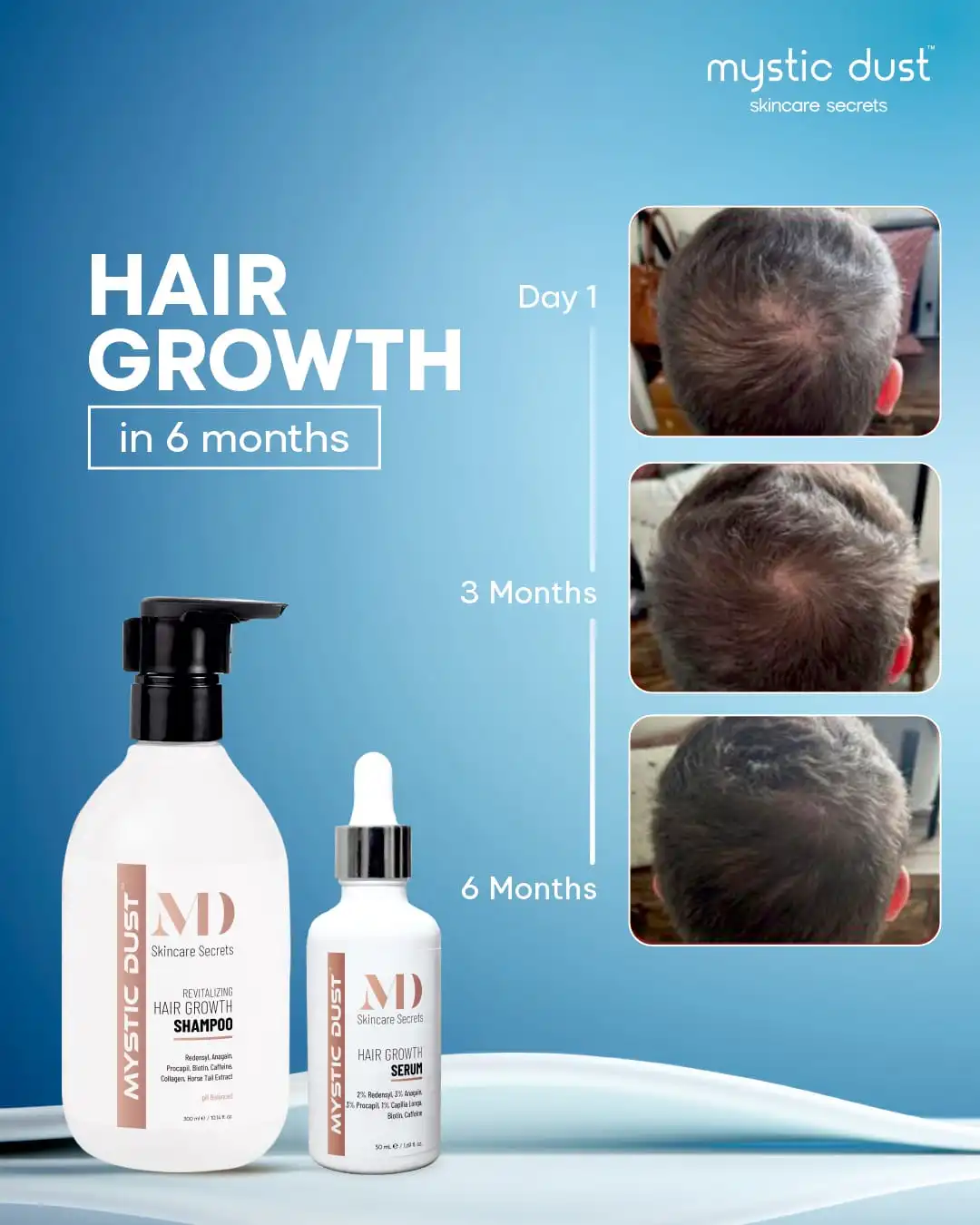
Formulated in Under Eye Gel (alongside Eyeseryl peptides and Niacinamide), and as Encapsulated Caffeine in Hair Growth Serum, alongside plain Caffeine in Hair Growth Shampoo and Scalp Reset Shampoo. Also formulated into the Scalp Strength Advanced Hair Growth Shampoo, alongside Redensyl, Anagain and Saw Palmetto.
Peptides (Eyeseryl, Matrixyl) for under-eye use; Redensyl, Anagain and Niacinamide for scalp/hair use — all already formulated alongside caffeine in the relevant Mystic Dust products.
Nothing specific at cosmetic concentrations.
According to PubMed: - Herman A, Herman AP. “Caffeine’s mechanisms of action and its cosmetic use.” Skin Pharmacology and Physiology, 2012;26(1):8-14. DOI

Copyright © 2024–2026, Oriens Health Pvt. Ltd. | All Rights Reserved




Give your friends a reward and claim your own when they make a purchase.